

As we observe National Retirement Security Month this October, let’s take some time to pause and think about the future. Even if retirement feels far away, the earlier you understand your options, the more secure your tomorrow becomes.
One of the most important financial decisions you’ll make is how you save for retirement. At the heart of that choice is your retirement account. Let’s take a look at Traditional vs. Roth IRAs.
IRA Basics: Traditional vs Roth
An IRA (Individual Retirement Account) is a tax-advantaged way to save for retirement. You can open and contribute to more than one IRA. Contributions may be made anytime during the year, including retroactively for the prior tax year up to the tax-filing deadline. This deadline does not extend if you file for a tax-return extension. However, the IRS sets annual limits on the total amount you can contribute across all IRAs.
These contribution limits are updated each year and may vary based on your earned income and age. For example, if you are single and earn $2,000, your maximum IRA contribution is capped at $2,000. For married couples filing jointly, each spouse can contribute up to their individual limit, if the combined contributions do not exceed the couple’s total taxable income.
In addition, individuals aged 50 and older are eligible to make catch-up contributions. This provision allows them to contribute an extra amount beyond the standard annual limit, helping those closer to retirement save more aggressively.
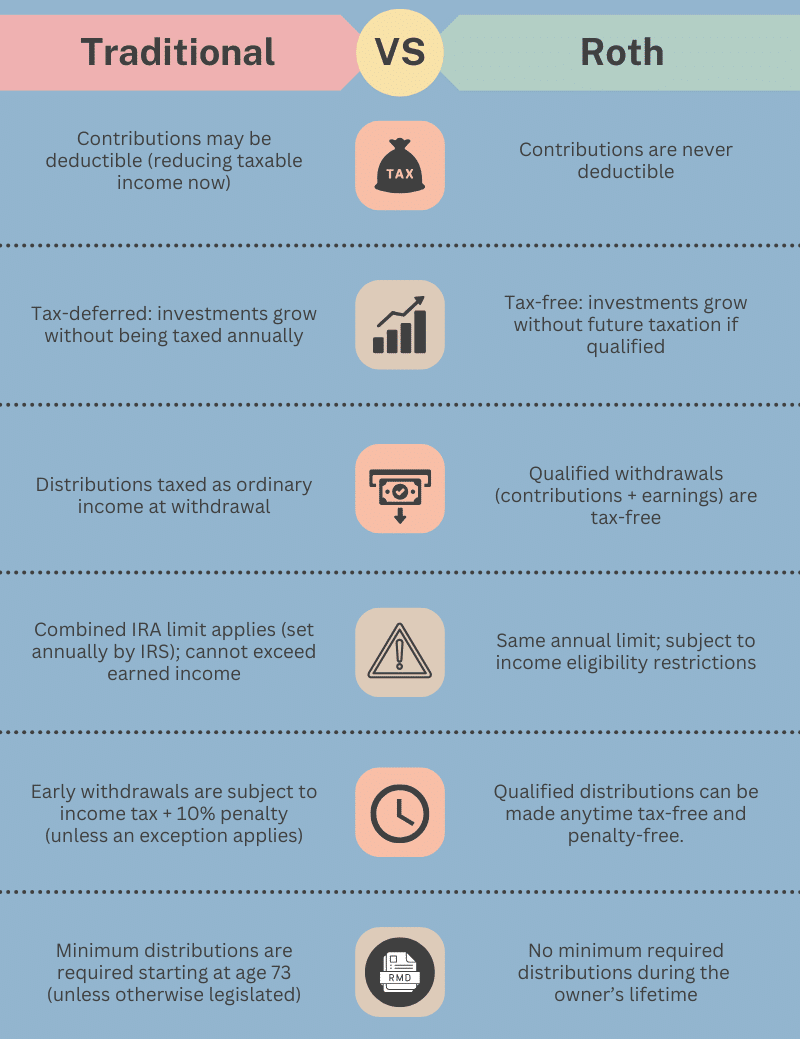
Taxability – Traditional IRAs
Contributions to Traditional IRAs are tax deferred. This means that your investments will grow each year without being taxed. When you take distributions in retirement, the withdrawals are taxed as ordinary income. Contributions may be deductible on your tax return, reducing your taxable income now; but if you (or your spouse) is covered by an employer retirement plan, the deduction can be reduced or phased out if your income is above a certain threshold.
Additionally, you must begin taking required minimum distributions (RMD) by April 1st of the year following the year you reach age 73. Any early withdrawals (before age 59 ½) may be subject to a 10% penalty, plus taxes, unless an exception applies.
Taxability – Roth IRAs
Contributions made to a Roth IRA are always made with after-tax dollars; and these contributions cannot be deducted on your tax return. There are income limits, based on your modified adjusted gross income, that can reduce your eligibility to contribute to a Roth IRA.
Minimum distributions are not required for Roth IRAs. Since contributions made to Roth IRAs are taxed as you make them, you can withdrawal your contributions tax-free and penalty-free if the distribution is qualified. A qualified distribution generally requires that the Roth IRA has been held for at least 5 years from the first contribution made, and one of the following applies:
- The owner is age 59 ½
- The distribution is due to disability
- The distribution is made to a beneficiary due to death
- The distribution is for a first-time home purchase (up to $10,000)
Tax Pro Tip: Backdoor Roth IRA Strategy
For individuals whose income is too high to contribute directly to a Roth IRA, a backdoor Roth IRA strategy may be an option. This involves contributing to a pre-tax retirement account, like a traditional IRA, which has no income limits for non-deductible contributions. Then, converting those funds into a Roth IRA. While the process can be beneficial, it involves paying taxes during the conversion year, so it’s important to understand the rules or consult a tax professional before using this approach.
Excess Contributions & Penalties
Contributing more than the allowable amount can happen. Excess IRA contributions can occur if you make an improper rollover contribution to an IRA, due to an overlooked recurring contribution, mis-projected income or confusion over limits.
The IRS imposes a 6% penalty for each year the excess amount remains in your IRA. If you over-contribute, you can avoid the penalty by withdrawing the excess (and any earnings) by the tax filing deadline for that year. You will then need to report the earnings as income on your tax return.
Rollovers: Moving Money Wisely
A rollover is when you move funds from one retirement account to another, allowing you to keep your savings invested and tax-advantaged without triggering unnecessary taxes or penalties. Rollovers often occur when a person changes jobs, wants to consolidate multiple accounts, or prefers a broader investment option. There are two main ways to complete a rollover:
- Direct Rollover | Funds are transferred directly from your old plan to a new IRA or retirement account. No taxes are withheld, and there’s no risk of penalties. This method is the simplest and is generally recommended.
- Indirect Rollover | Funds are paid directly to you, and you have 60 days to deposit them into another retirement account. If you miss the deadline, the distribution becomes taxable, and an early withdrawal penalty may apply. This method can only be done once every 365 days.
Strategic Thoughts
Retirement planning is highly personal, and the right approach depends on your unique circumstances. National Retirement Security Month is a good opportunity to evaluate whether your current strategy aligns with your long-term goals. Two important factors to weigh are your current tax situation and how it may change in retirement.
- If you expect to be in a higher tax bracket later, Roth contributions may be appealing since qualified withdrawals, including your earnings, are tax-free.
- If you anticipate being in a lower tax bracket in retirement, the traditional contributions may provide greater benefits by reducing taxable income now.
For more tailored tax advice, the accountants at Murtha & Flischel are available year-round (not just at tax time) to help you make confident and informed decisions about your retirement savings. While we can guide you on the tax side, investment choices are equally important. For recommendations specific to your financial situation, we encourage you to consult with a licensed financial advisor.